Overview
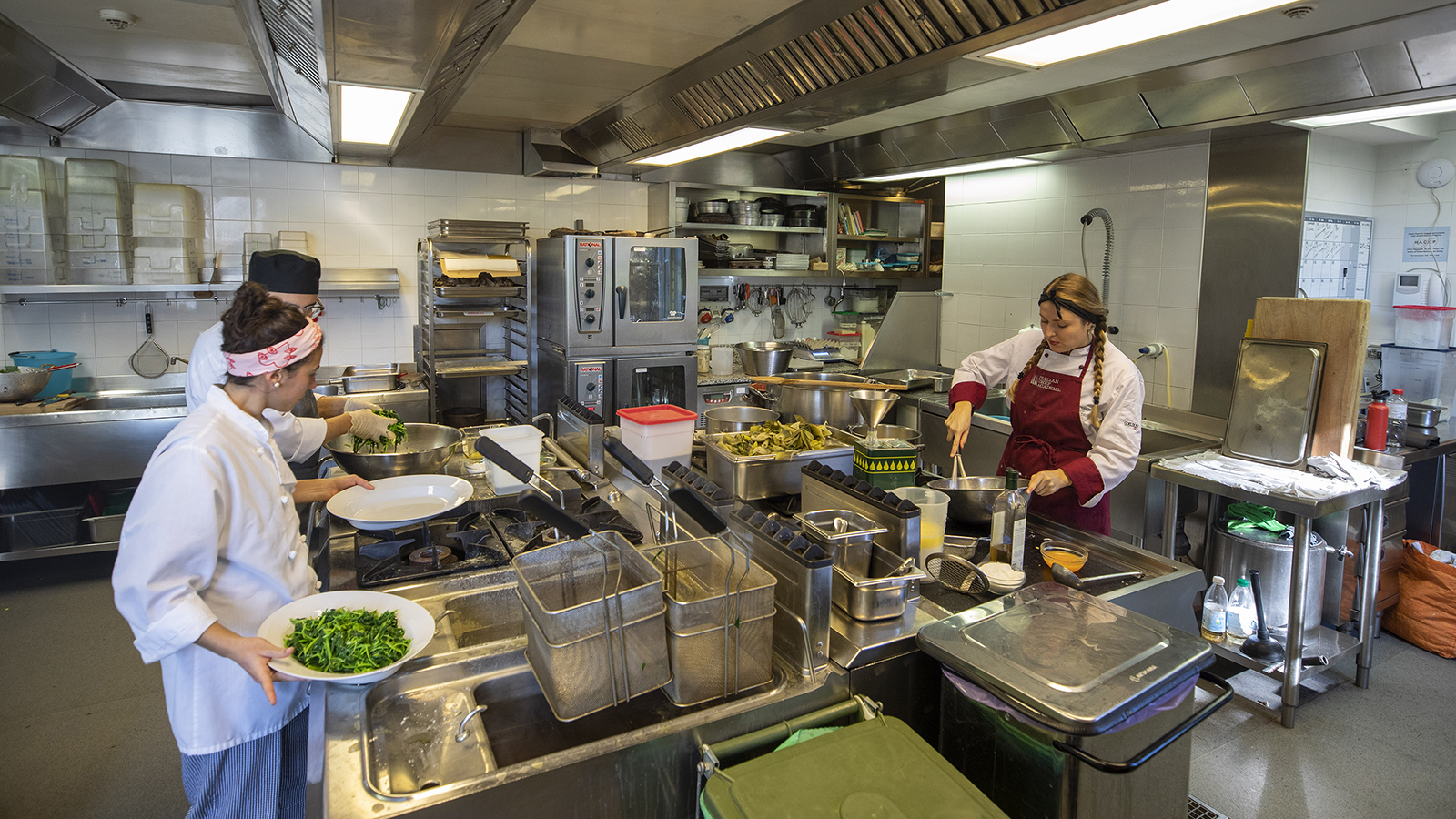
The Rome Sustainable Food Project is at once a production and teaching kitchen whose daily success relies strongly upon a team of interns. Living and training in Rome for a period of five-and-a-half months, they learn alongside an American and Italian kitchen staff to cook for the Academy community.
The teaching philosophy of RSFP chefs takes root in a practical, hands-on approach to learning. By “diving in” to the busy workday of a professional kitchen, interns learn to prepare seasonal produce with a multitude of techniques. In so doing, they gain extensive knowledge in Roman and Italian culinary practices, as well as practical experience cooking for large groups in the style of a banquet. Twice daily menu meetings are an essential part of the internship education: in them, interns receive their assignments from the chef and learn the history of a dish and its preparation from start to finish.
RSFP interns have varied experiences and come from diverse backgrounds. From cooks with substantial professional experience to culinary school students and food-interested individuals with other forms of education, they are committed to practices of sustainability and the experience of life in a professional kitchen. Most interns are also interested in Italian food and culture. It is essential that interns contribute to the teamwork that makes the kitchen run, especially at times when the work is fast-paced and intense.
How It Works
Interns train on average forty hours per week with two full days off.
Schedules may vary week to week so that interns have the opportunity to train both morning (between 7:00am and 4:30pm) and evening (between 12:30pm and 10:00pm) shifts. Shift times, however, do vary with a given day’s workload, and interns are expected to contribute as needed.
Intern responsibilities include: cooking, cleaning, composting, and recycling kitchen waste and organizing inventory (to name a few). Interns become involved in practically every aspect of the working kitchen. As interns are increasingly experienced, they take full responsibility for dishes from prep to plate.
The first few weeks of the internship are a period of transition and immersion into a new environment. Interns get to know the staff and a new kitchen, as well as learn the basics of the schedule, local ingredients, kitchen systems, and the rhythm of the workday. The hope is that interns will become familiar with the ins and outs of the RFSP after finishing their first two weeks with the program.
Thereafter, they will meet with the Head Chef for a review of their work on a regular basis. These meetings are intended as shared dialogues and provide the chefs as well as the interns with an opportunity to chart progress and define goals for the internship period. At any time, an intern can schedule a meeting with the Head Chef to discuss progress or any matters of concern.
The RSFP internship position is paid with a small benefit. For some of the internship slots, room and board are also provided.
Considerations
Culture shock is understandable and to be expected, so allowing oneself time to settle into the Academy prior to beginning the internship is generally a good idea.
Interns are encouraged to begin learning Italian before their arrival in Rome—an open-minded attitude toward the acquisition of a new language is a must. Working in a professional kitchen is fast paced and can feel hectic and often physically and mentally challenging.
Interns are trained to work efficiently and, most importantly, to be present and conscious in all aspects of the life of a professional chef. The work schedule is rigorous and while interns are encouraged to explore Rome as much as possible in their time off, extensive travel throughout Italy and Europe is generally discouraged during the internship period itself. Many interns opt to travel before they arrive or after they depart. Allowing oneself to be fully immersed in the RSFP, in life at the Academy, and in the culture of Rome at large is hugely beneficial to a positive internship experience.
Interns interested in bringing spouses or partners are required to live offsite, as the Academy has limited accommodations. Please be aware that the RSFP cannot provide living stipends to cover offsite housing costs. In the past, we have found that the internship experience is significantly altered by the presence of one’s spouse or partner. Some have encountered challenges in balancing the demands of work and their relationship in this particular context.
The RSFP internship provides interns with a unique opportunity to become well-acquainted with the city of Rome and the rhythm of Roman life. The Academy is situated on the Janiculum Hill in the Monteverde neighborhood and directly adjacent to the historic neighborhood of Trastevere.
How to Apply
There are two internship periods available every academic year. Internships are usually five-and-a-half months.
To accommodate a smooth transition, interns may be asked to arrive and/or depart on alternative dates and will be advised in advance.
The following documentation will be required:
- Personal Statement (your written statement describing why you would be suited for the internship)
- Résumé or CV
- A medical note from your primary physician that shows you are physically and psychologically able to undertake an internship in a professional kitchen abroad
- A copy of last diploma/degree/certificate/any other study or course qualification
- A clear, legible copy of the photo identification page of your passport. This should include your full name, passport number, date of birth, and expiration date. A scanned PDF is preferred. Please ensure all details are clearly visible and that no parts are cut off
- Two letters of recommendation
Applications must include two letters of recommendation from either current or past employers or teachers that follow these requirements:
- Recommender must be kitchen-related (cooking classes, kitchen training, restaurants, culinary experiences)
- From your current or most recent job
- From chefs/manager that worked with you
- Written with the logo/letterhead from the establishment you both worked together
- Contain the contact information (phone, email) of the recommender
- Contain your name and contact information (phone, email)
- Contain the signature of the recommender
Important Note: If a recommendation is provided by a chef the applicant worked with in the past, the letter must be on the official letterhead of the establishment where they worked together. If the chef is now employed at a different restaurant, they should not use their current letterhead for the recommendation.
Internship Dates and Deadlines
Session I
August 25, 2026 – January 15, 2027
Application deadline: March 2, 2026. APPLICATIONS ACCEPTED FOR BOTH SESSIONS
Applicants notified: end of March 2026
Session II
January 18, 2027 – July 9, 2027
Application deadline: September 7, 2026
Applicants notified: beginning of October 2026
Selection Process
The Rome Sustainable Food Project receives far more applications for internships than it can absorb for the four internship slots and is thus unable to accept all qualified and enthusiastic applicants. In selecting interns, the RSFP pays close attention to the group being assembled, as interns work together closely. It is the RSFP’s priority to create a dynamic environment in the kitchen that reflects the interdisciplinary nature of the Academy itself. Therefore, each group of interns is comprised of individuals with professional culinary experience as well as those with backgrounds in, but not limited to, food journalism, organic farming, sustainable food politics, Italian food culture and history, etc. Depending on the intern cohort, some preference may be given to applicants with significant prior cooking experience.
Timeline
Applicants will receive confirmation once their application is complete and has been processed. The results of the selection will be sent approximately a month after the submission deadline.