Exhibition – Giorgio Griffa / Kamrooz Aram: Paintings
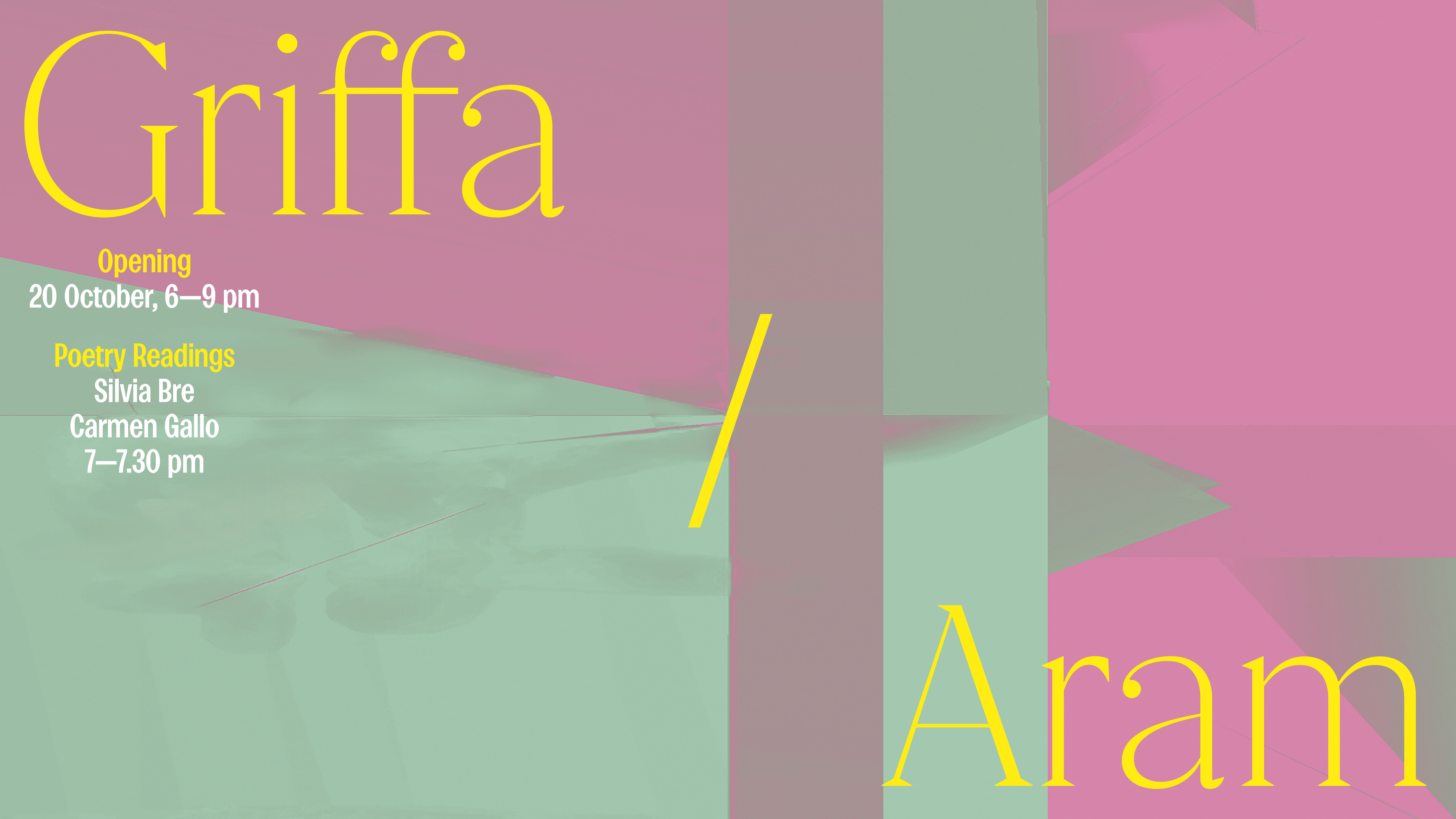
The American Academy in Rome presents Giorgio Griffa / Kamrooz Aram: Paintings, an exhibition that creates a dialogue between two painters whose work illustrates how abstract painting reverberates across time and space. The painters Giorgio Griffa and Kamrooz Aram (2024 Carla Fendi Foundation Rome Prize Fellow) met in 2024 in Turin, and this exhibition extends a conversation they began about the place and purpose of cultural tradition, painting as a measure of time and rhythm, and how gesture is traced and captured. The exhibition addresses this ongoing dialogue on abstraction, reflecting on different approaches to ornament and decoration, presence and loss, margins and intimacy. The show will be on display from October 23 to November 28, 2026 at the AAR Gallery, open on Fridays and Saturdays from 4 to 7 PM.
For the opening, contemporary Italian poets Silvia Bre and Carmen Gallo read a selection of poems chosen to reflect the themes of the exhibition. Both authors work with language in an organic way, crafting vivid images and evocative atmospheres while revealing a deep engagement with the truth-making power of language.
The American Academy is grateful to the exhibition lenders Alexander Gray Associates, New York, and Galleria Lorcan O’Neill, Rome; and the Fondazione Giorgio Griffa, Turin.
The project is part of the cultural programming of the exhibition Giorgio Griffa: Paths in the Forest at the Clark Art Institute; supported by the Directorate-General for Contemporary Creativity of the Italian Ministry of Culture under the Italian Council program (2025).
Giorgio Griffa was born in Turin in 1936 and began painting as a child. By the mid-1960s, his canvases already displayed the first elements of abstraction and a profound reflection on the nature of painting itself. In 1967–68, with the "Segni primari" (Primary Signs) series, he developed his distinctive working method: painting on paper or unstretched, unprimed canvases laid directly on the floor, using marks and lines that, in his words, "could belong to anyone's hand." From the outset, Griffa emerged as a leading figure in the artistic discourse that grew out of Informal Art, alongside the rise of Pop Art, Minimalism, and Conceptual Art. During this period, he forged his own singular artistic path working alongside friends in the Arte Povera movement, with whom he shared a deep respect for and interest in the intelligence of materials.
After more than fifty years of artistic practice and thirteen painting cycles, Griffa's work remains distinctive and independent of any single artistic movement. Held in museum and private collections around the world, from the Tate Modern to the Centre Pompidou, his paintings are instantly recognizable for their characteristic marks and colors, a visual language that carries remarkable continuity, coherence, vitality, and poetry from one work to the next.
Kamrooz Aram (2024 Carla Fendi Foundation Rome Prize Fellow) was born in Shiraz, Iran and lives and works in Brooklyn, NY, USA. His work disrupts the false opposition between ornament and abstraction, and challenges ornament’s relegation to discourses of criminality and excess. In his wide ranging exhibitions, he stages an encounter between the Euro-American avant-garde and non-western forms of abstraction, interrogating the boundaries between art, artifact, and modes of display. His lyrical paintings and arrangements break down the hierarchies of modernist aesthetics, asking that we rethink its categories and re-encounter these ideas and objects anew. Combining painting, sculpture, collage and exhibition design, he creates an interdependence between object and display, revealing the significance of design and architecture in affecting the interpretation of art.
Recent exhibitions include Whitney Biennial 2026, Whitney Museum of American Art, New York (2026); Kamrooz Aram: Privacy, An Exhibition, The Arts Club of Chicago, IL (2022); Lives of Forms: Kamrooz Aram and Iman Issa, Z33 House for Contemporary Art, Design and Architecture, Hasselt, Belgium (2021); Paraventi: Folding Screens from the 17th to 21st Centuries, Fondazione Prada, Milan, Italy (2023–2024); and Desorientalismos, Centro Andaluz de Arte Contemporáneo, Seville, Spain (2020). His work is in the collections of The Metropolitan Museum of Art, New York; M+ Museum, Hong Kong; Art Gallery of New South Wales, Sydney, Australia; Modern Art Museum of Fort Worth, TX; Cincinnati Art Museum, OH; Portland Museum of Art, ME; and Sharjah Art Foundation, United Arab Emirates, among others. He is the recipient of the Trellis Art Fund Stepping Stone Grant (2025), Guggenheim Fellowship (2025), Carla Fendi Rome Prize from the American Academy in Rome (2024), and Abraaj Group Art Prize (2014). He is also represented by Green Art Gallery, Dubai, UAE.
Silvia Bre is a poet and translator. She has published I riposi (Rotundo), Sempre perdendosi (nottetempo), and, with Einaudi, the poetry collections Le barricate misteriose, Marmo, La fine di quest’arte, and most recently Le campane. In 2022, she published the essay Mistero with Vallecchi. Her translations include works by Louise Labé, Claudia Rankine, Vita Sackville-West, and Margaret Atwood, as well as Emily Dickinson’s Centroquattro poesie, Uno zero più ampio, and Questa parola fidata, published by Einaudi. More recently, she translated Robert Frost’s Fuoco e ghiaccio for Adelphi. Einaudi’s Tascabili series has also published her translation of an extensive collection of Emily Dickinson’s poems.
Carmen Gallo is a poet and translator. Her recent poetry books include Tecniche di nascondimento per adulti (Italo Svevo, 2024), Stanze per una fuga (La Vita Felice, 2025), and Procne Machine (Einaudi, 2026), which was named a finalist for the 2026 Strega Prize. Her collection Le fuggitive (Aragno, 2020) was awarded the Premio Napoli. She has written on the metaphysical poetry of John Donne and translated works by William Shakespeare, T.S. Eliot, Caryl Churchill, Hannah Sullivan, and others. She teaches English literature at Sapienza University of Rome.
Tuesday, October 20, 2026
6:00–9:00 PM
For access to the Academy, guests will be asked to show a valid photo ID. Backpacks and luggage with dimensions larger than 40 x 35 x 15 cm (16 x 14 x 6 in.) are not permitted on the property. There are no locker facilities available. You may not bring animals (with the exception of seeing-eye/guide dogs).
The Academy is accessible to wheelchair users and others who need to avoid stairs. Please email us at events@aarome.org if you or someone in your party uses a wheelchair or other mobility devices so that we can ensure the best possible visitor experience. If you are someone with a disability or medical condition that may require special accommodation, please also email us at events@aarome.org.