Material Ways of Knowing: Material Intelligence on the Eve of Artificial General Intelligence
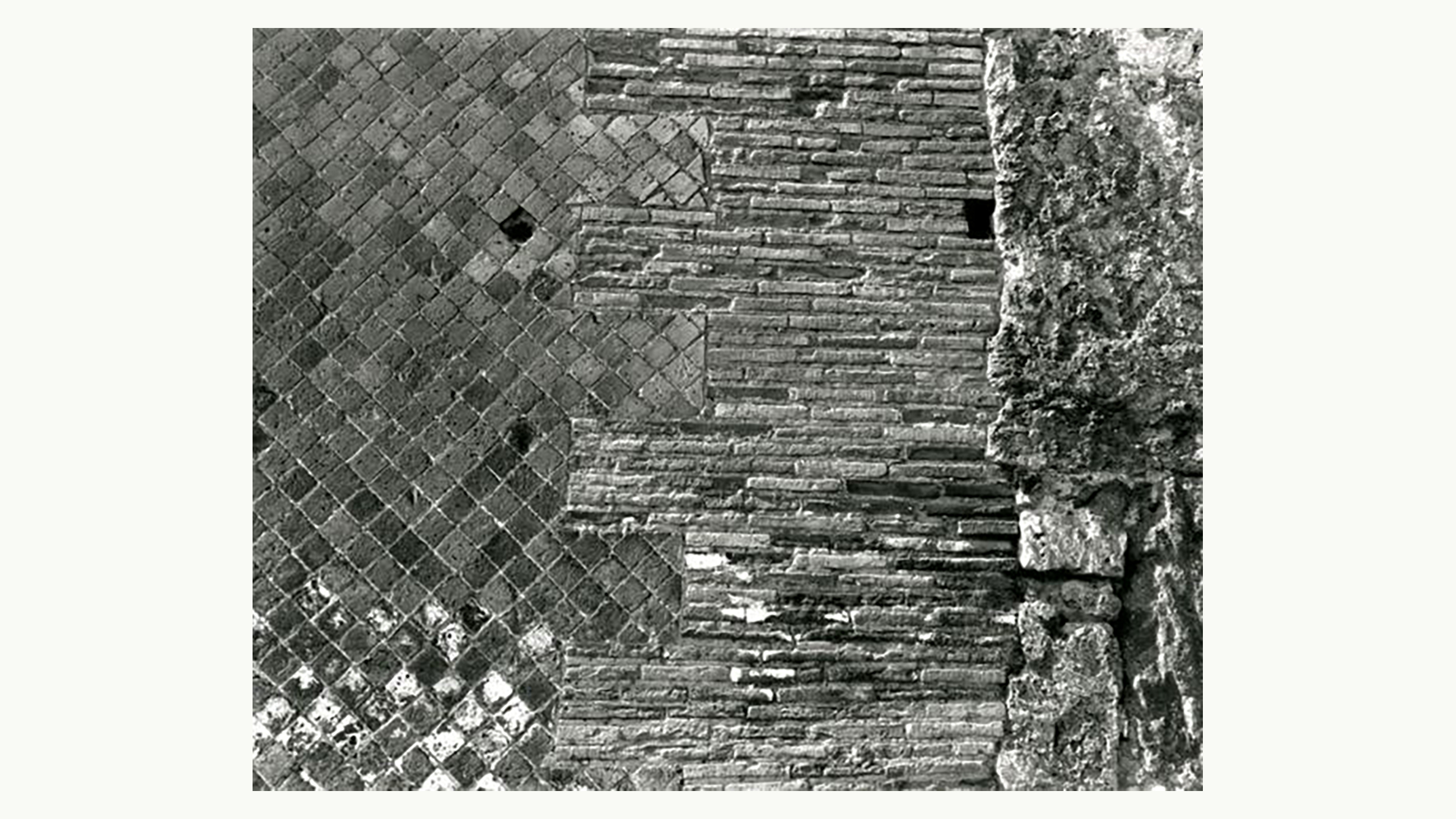
[Photo: Esther Van Deman, Pompeii (Italy), opus reticulatum and bricks, 1910-20]
This event is part working group, part think-tank, and part walking seminar. A group of artists, archaeologists, and engineers/scientists will come together in Rome to develop an argument about the kind of knowledge that can be derived from materials of the past by bodies/agents in the world. We also will explore the potential of three-cornered conversations between artists, humanities scholars, and scientists. Each participant in this group comes with a set of expertise and bodies of knowledge; working together on sites and with objects, we work to generate the somewhat magical process of producing knowledge from encounters between individuals and things. We will take advantage of the city of Rome as a dense site of artefacts and research on those materials.
The American Academy in Rome has played an important role in archaeology in Italy over the past century. Asking about the future of archaeology now means asking about what we can learn from things—artifacts and places—and, indeed, from bodies, in an age of language-driven machine learning. What defining human knowledge has come from our species’ material intelligence? And what of this can be preserved into the coming age of Artificial General Intelligence? Put another way, what kind of knowledge cannot be derived from language? These are the questions that will be explored at this multidisciplinary conference bringing together artists, scholars of humanities, and scientists. The conference will center ways of doing and knowing that have been essential to the progress of civilization, often developed by groups that have been marginalized in the annals of history. Material Intelligence on the Eve of Artificial General Intelligence extends the American Academy in Rome’s century-long commitment to examining the material world through the lens of Rome. The conference will take place over three days. We open the doors to a public conversation on the evening of Monday, March 16, and otherwise will have several closed workshops and seminars on Monday through Wednesday, March 16-18.
Monday, March 16 – Open to the public
A conversation between Stefanie Hessler, curator, writer, and Director of the Swiss Institute in New York; Hideo Mabuchi, physicist and Professor of Applied Physics at Stanford University; and Wolfgang Schäffner, Chair of the History of Culture and Knowledge at the Institute for Cultural History and Theory at Humboldt University. Each of these thinkers has contributed to the state of current thinking on materialities and how people learn, and have learned in the past, through materials and our experience of them. They will each present some of their work and will, in dialogue, probe the contours of human knowledge through materials and the questions that artificial intelligence raises for learning through and from materials.
Monday, March 16 to Wednesday, March 18 – Closed sessions
A series of workshops, seminars, and site visits with conference participants.
Project Leads
Jaś Elsner (Classics, University of Oxford)
Caroline Goodson (AAR/History, University of Cambridge)
Hideo Mabuchi (Applied Physics, Stanford University)
Pamela Smith (History, Columbia University)
Participants List
Makers
Simon Levin (Mill Creek Pottery)
Camille Utterback (Art and Computer Science, Stanford University)
Nick Benson (The Johns Stevens Shop)
Emily Pegues (Curator, NGA, WDC)
Dario Robleto (Artist, University of Texas)
Humanists
Chris Gosden (Archaeology, University of Oxford, em.)
Janet DeLaine (Classics, University of Oxford, em.)
Emily Pegues (Curator, National Gallery of Art, WDC)
Verity Platt (Classics and Art History, Cornell University)
Scientists
Naomi Leonard (Engineering, Princeton University)
Hidenori Tanaka (Physics, Harvard University)
Tiziana Vanorio (Earth and Planetary Sciences, Stanford University)
Anthony Leonardo (Neurotechnology, Howard Hughes Medical Institute)
For access to the Academy, guests will be asked to show a valid photo ID. Backpacks and luggage with dimensions larger than 40 x 35 x 15 cm (16 x 14 x 6 in.) are not permitted on the property. There are no locker facilities available. You may not bring animals (with the exception of seeing-eye/guide dogs).
The Academy is accessible to wheelchair users and others who need to avoid stairs. Please email us at events@aarome.org if you or someone in your party uses a wheelchair or other mobility devices so that we can ensure the best possible visitor experience. If you are someone with a disability or medical condition that may require special accommodation, please also email us at events@aarome.org.