The Past, Present, and Future of Research: What Humanists, Artists, and Scientists Can Learn from Each Other. A Collaboration Between Aspen Institute Italia and the American Academy in Rome
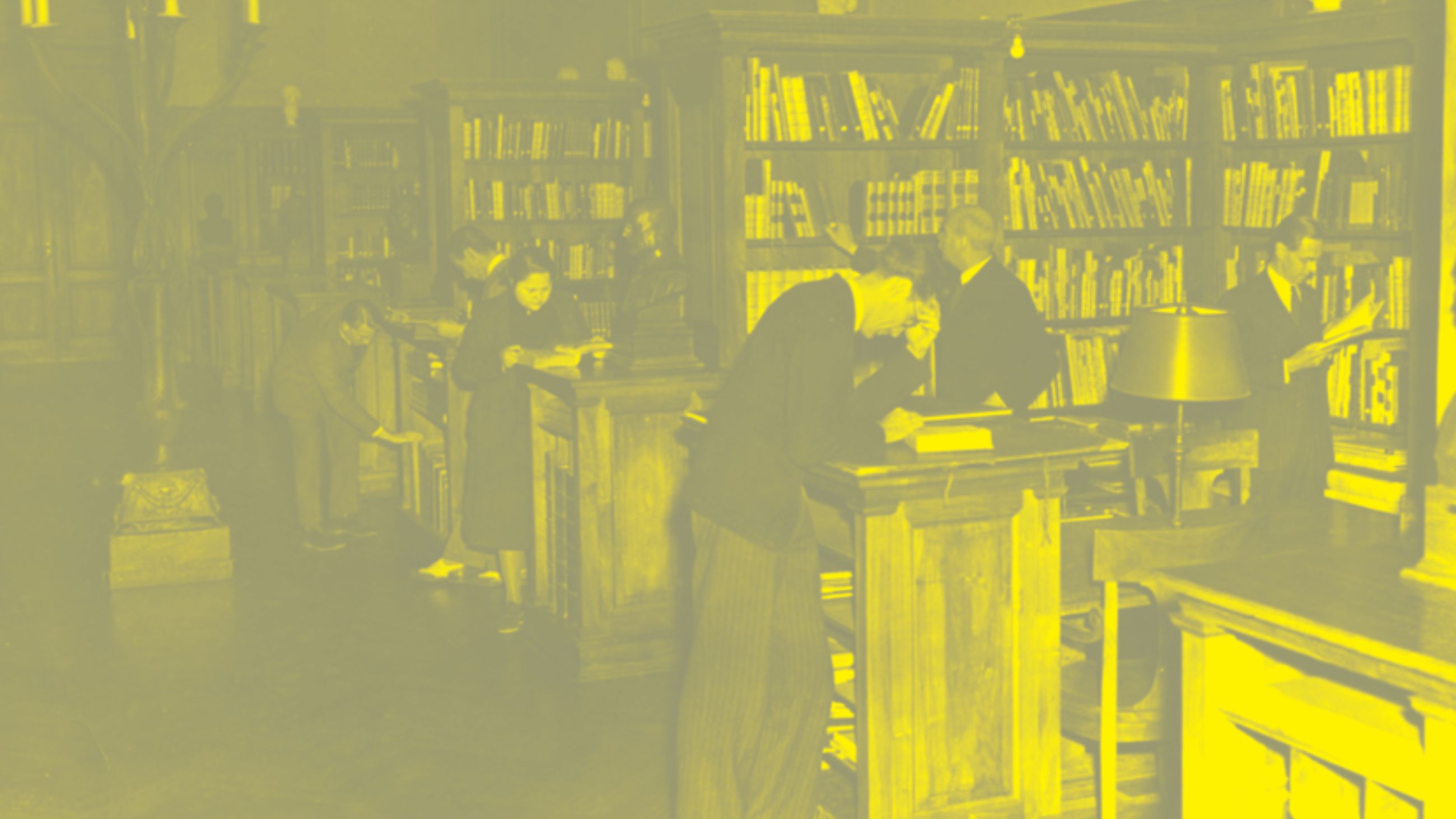
1940 Fellows in the Library of the American Academy (Rome, Italy)
“Research” is something that until very recently has seemed so self-evident as to deserve no comment. Across Europe and North America there has been only scattered attention to the subject and even less to comparing research as practiced in the Arts, Sciences, and Humanities. This conference, bringing together historians and practitioners of research, aims to show how our understanding of this important subject is expanded by treating it comparatively; by putting different aspects of it into conversation; and by looking both to the past and the present in order to think better about the future.
The proposal builds on a range of former initiatives taken in the past years by Aspen Institute Italia under the headings of “Pure Science” and “Democracy and the Arts.” Similarly, in the last decades there has been a burst of interest in artistic research, making it an exciting topic for the American Academy in Rome, which has been bringing artists and scholars together since 1911.
In this day-long event structured as a series of conversations between artists and scholars, we want to understand how artists and scholars think about research. For both, research usually functions as a means to an end; as preparation for the work. We are interested in the possibilities of new forms of scholarly and artistic expression in which research is the work, not the thing that is discarded or hidden upon achievement of the work.
We are interested in what scholars can learn from artists about research. In this we are guided by the words of Robbert Dijkgraaf, the physicist and former Director of the Institute for Advanced Study in Princeton, who explained that scholars can learn, precisely, the doing of “unpredictable things, implying intuition and some measure of randomness.” Artists and scholars are “explorers,” and both are “by definition” going into an “unknown” where breakthroughs occur—and where things can go wrong.
The conference will take place on Monday, May 4, 2026 at the homes of Aspen Institute Italia and the American Academy in Rome. It begins at Aspen’s Palazzo Lancellotti (Piazza Navona) with a morning session by invitation only and moves to the American Academy’s Villa Aurelia (Largo di Porta S. Pancrazio) for the afternoon public session and panel discussion.
Major support is provided by an Anonymous Donor.
Full program here.
Monday, May 4, 2025
For access to the Academy, guests will be asked to show a valid photo ID. Backpacks and luggage with dimensions larger than 40 x 35 x 15 cm (16 x 14 x 6 in.) are not permitted on the property. There are no locker facilities available. You may not bring animals (with the exception of seeing-eye/guide dogs).
The Academy is accessible to wheelchair users and others who need to avoid stairs. Please email us at events@aarome.org if you or someone in your party uses a wheelchair or other mobility devices so that we can ensure the best possible visitor experience. If you are someone with a disability or medical condition that may require special accommodation, please also email us at events@aarome.org.