Exhibition Opening: Flight Paths
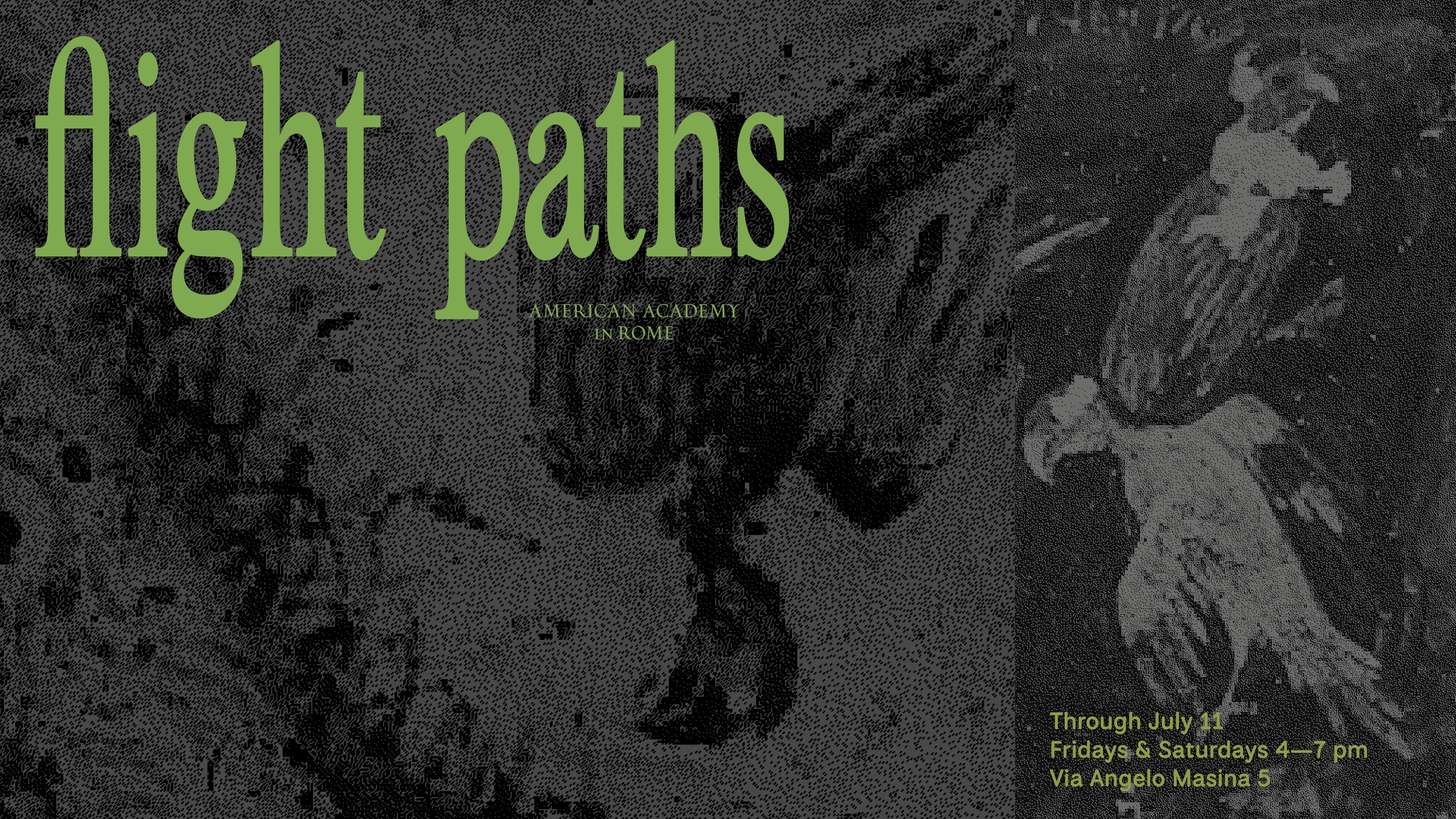
Flight Paths transforms the story of Rome's beloved (and much maligned) parakeets into an exploration of urban environments, planetary ecology, and the entangled histories connecting humans, birds, and cities across millennia.
In 1999, more than one thousand parakeets arrived at Fiumicino Airport in large cages. Faced with this unexpected cargo, authorities released the birds into the open air. Today, rose-ringed parakeets (Psittacula krameri) and monk parakeets (Myiopsitta monachus) have become an integral part of Rome's identity, filling the city's parks with their presence while raising urgent questions about adaptation, ecology, and coexistence.
Flight Paths reveals that these so-called "alien" or "invasive" species have a far more complex relationship with the Mediterranean world than contemporary labels suggest. Exotic birds circulated in antiquity as symbols of power, empire, and global trade, connecting Ancient Rome to Afro-Asian geographies. By tracing these entangled histories, the exhibition positions birds as vital indicators of urbanism, adaptation, and environmental change—demonstrating that the life of a city can literally be read from a bird's-eye view.
Flight Paths bridges into the contemporary with an exceptional roster of international artists and architects including Allora & Calzadilla, Alvin Curran, Craig Douglas (2023 Affiliated Artist), Chioma Ebinama, Studio Gang (2017 Resident), Heather Hart (2026 Fellow), Joan Jonas, Ana Mendieta (1984 Fellow), Cassi Namoda, Laura Owens, STIMSON (2024 Fellow), Anika Roach, Raqs Media Collective, Roberto Zhao Renhui, alongside a dynamic younger generation of Italian artists—Catherine Biocca, Michela De Mattei, Michele Gabriele, Sara Ravelli, and Giorgio Orbi, 16th century author François Le Gouz de La Boullaye and the unknown authors from the archaeological collections of the American Academy in Rome and the National Roman Museum. They each use birds as powerful indicators of ecological and political disruption across diverse geographies spanning North America, the Caribbean, and Southeast Asia, engaging contested concepts of population, migration, and extinction.
Through painting, sculpture, sound, architecture, film, and archival materials, Flight Paths explores how human and non-human habitats transform under climate stress and resource scarcity. The exhibition foregrounds creative, interdisciplinary exchanges between the arts, sciences, and humanities, bringing religious, political, scientific, and poetic responses to urban birdlife—from antiquity to the present—into dialogue.
At a moment when urban environments worldwide face rapid transformation, Flight Paths positions Rome as both illuminating case study and vital crossroads—a place where history, ecology, and imagination take flight.
The opening is proceeded by a conversation Sharing Our World with Birds with scientist and microbiologist Andrea Crisanti, architect Jeanne Gang, and ornithologist Francesca Manzini from 6:00 – 7:00 pm.
The exhibition is curated by Ilaria Puri Purini, Andrew Heiskell Arts Director at the American Academy in Rome.
Following the exhibition opening on March 30, the exhibition will be open to the public from April 3 to July 11, 2026.
Opening hours: Fridays and Saturdays, 4:00 – 7:00 pm.
The American Academy in Rome gratefully acknowledges leadership support from an Anonymous Donor, Silvia & Jay Krehbiel, and the Tsao Family Foundation, with additional support from John Friedman.
Corporate support is provided by Poste Italiane S.p.A.
Allora & Calzadilla
Allora & Calzadilla are artists living and working in San Juan, Puerto Rico. Through a research-driven and interdisciplinary practice, they examine the intersections of history, material culture, ecology, and geopolitics. Working across performance, sculpture, sound, video, and photography, their projects engage both conceptual and material registers, attending to the metaphorical as well as the factual. Their work has explored themes such as collective action and ephemerality, the lasting imprints of colonial and military violence on landscapes and communities, the resonance of music across historical moments, and the entanglements of biophysics, semiotics, and lived reality.
Catherine Biocca
Catherine Biocca studied at the Kunstakademie Düsseldorf, where she earned her BA and MA in 2010 and 2013. Between 2014 and 2015 she was an artist-in-residence at the Rijksakademie van beeldende kunsten in Amsterdam. She currently lives and works in Rome, where she is assistant professor at John Cabot University in the Department of Art and Design. Her work has been shown in several international institutional and commercial exhibitions, such as the 3rd Shenzhen International Animation Biennale, Kunstverein Nürnberg, Kunstmuseum LOK St. Gallen, and Fondazione Volume! in Rome. She has received several recognitions and prizes, including the ALA Art Prize, Stiftung Kunstfonds, Berliner Senatsstipendium, ROSE Mambo, and Mondrian Fonds.
Alvin Curran
Alvin Curran is an American composer, performer, and sound artist known for experimental music that incorporates environmental sound, improvisation, and electronics. A founding member of the Rome-based collective Musica Elettronica Viva, Curran has explored site-specific performance, radio, and large-scale participatory works. His practice challenges distinctions between music and noise, composition and chance, emphasizing listening as a social, political, and ecological act.
Craig Douglas
Craig Douglas is a Landscape Architect whose work focuses on innovative techniques and methodologies that explore the agency of representation in landscape architectural design. He is an Assistant Professor in the Landscape Architecture Department at Harvard University. His work explores the landscape as a dynamic material process in a constant state of flux through analytical and conceptual approaches integrating drawing, modelling, simulation, and sensing to make visible and reconstitute the landscape as a complex temporal and material manifold of differential space.
Chioma Ebinama
Chioma Ebinama is an artist living and working in Athens, Greece, interested in how animism, mythology, and native philosophies can articulate a vision of freedom outside of neo-colonial paradigms. Her practice centres around watercolours on paper, a medium that elucidates the process of mark-making as a meditative act of self-liberation. Ebinama reflects on gender and queer identities through a figurative language that is informed by surrealism and Igbo culture. Raised in the United States by Nigerian Christian immigrants, Ebinama is drawn to the aesthetic potential to be found within formal religious practices, seeking to use these icons to celebrate narratives from her inner life and create new mythologies for the African Diaspora. The collision of aesthetics is indicative of Ebinama’s nomadic life which in recent years has carried her from Mexico, South Korea, India, Malaysia and now Greece.
Michele Gabriele
Michele Gabriele addresses the contrast between the digital and material worlds, exploring the feeling of inadequacy engendered by progressive visions of an eco-sustainable future against the disillusionment of their concrete realization. His practice examines the distances between representation and materiality and the divergences between space and time relative to the observer. Their work has been presented at venues such as: Musée d'art et d'histoire, Geneve; ICA Institute of Contemporary Art, Maine, Portland; 9th Berlin Biennale, Berlin; EACC Espacio de Arte Contemporáneo de Castellón, Castellon de la Plana, Valencia; MeetFactory, Prague; NAM, Manifattura Tabacchi, Florence; Ashes/Ashes, New York; Anno Domini, New York; International Objects, New York; Kunsthalle Ost, Leipzig; Studio E1 Paris; Alios 16ème Biennale d’Art Contemporain, La Teste-de-Buch; Gossamer Fog, London; Konstanet, Kunstihoone Art All, Tallinn; Fondazione Pini, Milan; Et al., San Francisco; MAN Museo d'arte della Provincia di Nuoro, Nuoro; Fondazione Spinola Banna, Turin; Museo Carlo Zauli, Faenza. They were Visiting Professor at Hochschule für Bildende Künst, Dresden and winner of Salon Primo Prize (2004), Museo della Permanente, Milan.
Jeanne Gang
Architect Jeanne Gang is the founding partner of Studio Gang, an international architecture and urban design practice based in Chicago with offices in New York City, San Francisco, and Paris. Drawing insight from ecological systems, Jeanne is recognized for a research-based design process that connects individuals, communities, and the natural environment. Her most recent award-winning architectural projects include the Gilder Center at the American Museum of Natural History in New York, the Arkansas Museum of Fine Arts in Little Rock, and the University of Chicago John W. Boyer Center in Paris. In addition to leading design at Studio Gang, Jeanne teaches and conducts research at the Harvard University Graduate School of Design as Kajima Professor in Practice of Architecture. In 2017 she was the William A. Bernoudy Architect in Residence at the American Academy in Rome. Published and exhibited widely, her work is in the permanent collection of the MAXXI, the Centre Pompidou, the Centre Canadien d’Architecture, the Art Institute of Chicago, and the Cooper Hewitt Smithsonian Design Museum.
Heather Hart
Heather Hart is an interdisciplinary artist exploring the power in thresholds, questioning dominant narratives, and creating alternatives to them. She was awarded grants from Anonymous Was A Woman, the Graham Foundation, Joan Mitchell Foundation, and the Jerome Foundation, NYFA, and Harpo Foundation. Her work has been exhibited at the Queens Museum, Storm King Art Center, The Kohler Art Center, NCMA, Eastern Illinois University, Seattle Art Museum, Brooklyn Museum, and University of Toronto, Scarborough among others. She was a Fellow at the Radcliffe Institute for Advanced Study at Harvard University and is a 2025-26 Rome Prize Fellow. Hart studied at Skowhegan, Whitney ISP, Cornish College of the Arts, Princeton University and received her MFA from Rutgers University. She is an Assistant Professor at Mason Gross School for the Arts, a member of the Black Trustee Alliance for Art Museums, an external advisor for AUC Art Collective, and a trustee at Storm King Art Center.
Joan Jonas
Joan Jonas is a world-renowned artist whose work encompasses a wide range of media including video, performance, installation, sound, text, and sculpture. Jonas' experiments and productions in the late 1960s and early 1970s continue to be crucial to the development of many contemporary art genres, from performance and video to conceptual art and theatre. Since 1968, her practice has explored ways of seeing, the rhythms of rituals, and the authority of objects and gestures.
Michela De Mattei
Michela de Mattei works across different formats and media, often developing fictional scenarios and unusual ecosystems in which animal–human affairs are hijacked by technologies. Her works question standards of authority and control, addressing issues of animal agency and the changing dynamics of communication systems. In 2025 she presented Paraflu (co-directed with Invernomuto) at GAMeC, Bergamo; Fondazione Prada, Milan; e-flux Screening Room, NY; Villa Medici, Rome; St. Moritz Film Festival; EMST, Athens, and took part in Premio Michetti, Bienal Sur and Nextones festival. Other exhibitions include: Belmacz, London (2024); MACRO, Rome (2024); Porto Design Biennale, Porto (2023); MAXXI L’Aquila (2022); MAAT, Lisbon (2021); Alserkal Avenue, Dubai (2019); ICI, London (2018); Serpentine Galleries / ZSL London Zoo (2018). In 2023 she published Brief Inventory of Animal Resistance, VOL.1 (Aniene, Rome).
Ana Mendieta
Born in 1948 Cuba and immigrated to the United States as a child following her father’s political persecution. This early experience of exile became a central, though often indirect, influence on her artistic practice, informing a sustained engagement with displacement, cultural dislocation, and fractured identity. Working in the United States during the 1970s and 1980s, Mendieta also confronted the structural marginalization of the art world as both a woman and a Latina artist. She was a fellow at the American Academy in Rome in 1983.
Cassi Namoda
Cassi Namoda is a painter whose work interweaves the personal with the historical. Born in Maputo and having lived in several different countries throughout her life, Namoda’s nomadic lifestyle and multicultural identity has long informed her work. She originally studied cinema and considers narrative frameworks, storytelling, and the presence of imagined characters to be significant elements in her visual practice. Reference images often serve as a starting point for her painting process: she is drawn to photographs that recall film-stills, images that echo ordinary yet profound moments of everyday life. Combining personal memories with archival references, she creates works that attempt to access emotional interiority and communicate human experience in all its subtlety. The duality between past and present, colonialism and post-colonialism, Africa and Europe, spiritual traditions and a globalised world is a latent force in her most recent paintings. An engagement with, and probing of, art history is a way of confronting the nuances inherent in conflicting ideologies and mutable identities. Her works often challenge art history and its canons. She relates expressionism to emotional intensity, dissonant tones and figural distortions, while surrealism manifests itself through an embrace of magical realism or through themes borrowed from tribal art.
Giorgio Orbi
Giorgio Orbi addresses the theme of landscape transformation and the evolution of artistic genres through moving images, sound, photography, sculpture, and installations. Orbi created Rave Immortal, a listening session that presents compositions, field recordings, interviews, and sounds drawn from the artist’s archive from the 1990s to the present, and of INTHEMOUNTAINS, a large-scale project that considers the mountain as both a cultural and natural display. His work was shown at The Mosaic Rooms (UK), Art, Ecology and The Commons (LB), Le Carreau Du Temple (FR), Haus Der Kulturen Der Welt (DE), Venice Architecture Biennale (IT), MAXXI (IT), Nuova Consonanza (IT), MACRO (IT), Auditorium della Conciliazione (IT), Palazzo delle Stelline (IT), and Galleria Alessandra Bonomo (IT).
Laura Owens
Laura Owens began exhibiting her work in the mid-1990s and quickly became known for her innovative approach to painting that infuses traditional methods with unconventional ones, including printmaking and digital manipulation. She combines these varied techniques to create destabilizing illusions of depth, extending her paintings beyond the confines of the canvas into three-dimensional space. Her work encompasses a wide range of references, from art history, decorative arts, and craft traditions, to mass media and personal anecdotes. In addition to her large-scale canvases, Owens’s practice extends to handmade books, wallpaper, and sculpture. Her work has been the subject of numerous one-person museum exhibitions, including the Cleveland Museum of Art (2021), the Fondation Vincent van Gogh in Arles, France (2021), the CCA Wattis Institute for Contemporary Arts in San Francisco (2016), the Secession in Vienna (2015). In 2017, a mid-career retrospective of her work was organized by the Whitney Museum of American Art in New York.
Sara Ravelli
Sara Ravelli lives and works in Milan. She works across sculpture, installation, and writing, investigating how emotional conditions such as vulnerability, exposure, and affection manifest within systems of power involving humans, other living beings, and objects. Her work explores how feelings can be mobilized to question control, hierarchy, and care. She received her BFA from the Accademia di Belle Arti G. Carrara in Bergamo and an MA from HEAD – Genève. Recent exhibitions include Liste Art Fair Basel (solo), OUCH! at BAR (Turin), Bouquet Final (Marseille), and It’s the Tip of the Iceberg at MASSIMO (Milan). She is the recipient of the Rome-New York Art Prize 2026.
Raqs Media Collective
Raqs Media Collective (founded in 1992, by Monica Narula, Jeebesh Bagchi and Shuddhabrata Sengupta). The word “raqs” in several languages denotes an intensification of awareness and presence attained by whirling, turning, being in a state of revolution. Raqs take this sense to mean ‘kinetic contemplation’ and a restless and energetic entanglement with the world, and with time. Raqs practices across several media; making installation, sculpture, video, performance, text, lexica, and curation. Their work finds them at the intersection of contemporary art, philosophical speculation and historical enquiry. Raqs has exhibited widely, including at Documenta, the Venice, Istanbul, Taipei, Liverpool, Shanghai, Sydney and Sao Paulo Biennales.
Anika Roach
Anika Roach is a British artist who is based between London and Vienna. Her current practice oscillates between excavated histories, images of the everyday and an imagined reality. These multiple elements intermingle and inform her visual vocabulary, accommodating dialogues of boundless interpretation. Recognisable imagery from film, sport and music as well as iconography from art history permeate the work. Their contemporary relevance enables her to magnify and contort entrenched notions of race, gender and impressions of nature. Literature also impacts the work and texts by bell hooks, Judith Butler, James Baldwin and C.L.R. James hold specific significance to the practice. Peculiar compositions, and the exaggerated perspectives of augmented realities take cues from features present in early Meso-American paintings and late Renaissance. While the work is also influenced by the symbolism of the 20th and 21st century from artists like Giorgio de Chirico to Kara Walker and Jacob Lawrence. Paintings feature a vibrant colour palette where thick opaque flat planes of colour juxtapose chalky thin washes of pigment. Rich primary colours intertwine with muted hues. And formal elements of abstraction, interact with refined lines to depict ambiguous often headless gestural figures. Thus, creating a confronting absurdity that places the viewers perspective at the centre of the work.
STIMSON
Lauren and Stephen Stimson, STIMSON
STIMSON is a landscape architecture collective led by partners, Lauren and Stephen Stimson. Studio work is varied, ranging from comprehensive planning and design of public parks and museums, college campuses and schools, and farms and gardens. The team of forty is spread across urban and rural studios located in the Northeast of the United States. Stephen founded the firm in 1992 after growing up on a dairy farm and studying landscape architecture at UMass Amherst and Harvard. Lauren’s interest in art, landscape and history was nurtured at Bates College in Maine, where she studied classical theater and geology, eventually pursuing a dual degree in landscape and planning from UMass Amherst. She joined the studio in 2006, and the pair have been working alongside each other ever since. Charbrook is a lifelong project that remains their home, studio, working farm, plant nursery and place of experimentation and inquiry. An open-minded and spontaneous spirit has encouraged a diverse body of work that reflects the independent interests of the entire STIMSON team, earning them the national Firm Award from the American Society of Landscape Architects (ASLA) in 2021. Steve has been a Fellow of the ASLA since 2004. Lauren was elevated to the ASLA Council of Fellows in 2025 and was the 2023/2024 Gilmore D. Clarke and Michael I. Rapuano | Kate Lancaster Brewster Rome Prize Fellow in landscape architecture at the American Academy in Rome.
Robert Zhao Renhui
Robert Zhao Renhui works mainly in photography but often adopts a multi-disciplinary approach by presenting images together with documents and objects to challenge the ways in which we commonly receive and accept information. He developed A Guide to the Flora and Fauna of the World, a work that aims to record and contemplate the many ways human activity is gradually reshaping nature. Drawing on the idea that all living organisms must continually evolve and adjust to shifting conditions or face extinction, Zhao’s Guide offers an inventory of unusual species that have adapted in surprising ways to survive the pressures of an altered environment.
Monday, March 30, 2026
6:00 – 9:00 pm
For access to the Academy, guests will be asked to show a valid photo ID. Backpacks and luggage with dimensions larger than 40 x 35 x 15 cm (16 x 14 x 6 in.) are not permitted on the property. There are no locker facilities available. You may not bring animals (with the exception of seeing-eye/guide dogs).
The Academy is accessible to wheelchair users and others who need to avoid stairs. Please email us at events@aarome.org if you or someone in your party uses a wheelchair or other mobility devices so that we can ensure the best possible visitor experience. If you are someone with a disability or medical condition that may require special accommodation, please also email us at events@aarome.org.